When Robots Take the Wheel

Isla
| 02-11-2026
 · Automobile team
Imagine watching a motorsport race where engines roar, cars battle for position and engineers monitor every movement, but nobody is sitting behind the wheel. That futuristic spectacle became reality at Italy's famous Imola circuit in September 2026.
Five international teams competed in Europe's first multi-car race for fully autonomous vehicles. The event offered more than high-speed entertainment: it demonstrated how artificial intelligence responds when machines must make split-second decisions without human intervention.

A Historic Race Without Drivers
The competition took place at the Autodromo Enzo e Dino Ferrari in Imola, a circuit famous for hosting Formula 1 races.
Teams from Germany, Italy and the United Arab Emirates participated in the event, organised through the Abu Dhabi Autonomous Racing League (A2RL).
Unlike conventional motorsport, the cars had no human drivers, steering wheels or pedals. Instead, advanced computer systems controlled their acceleration, braking and direction.
The 12-lap contest ended with victory for Kinetiz, a team representing the UAE. The result marked an important milestone for autonomous racing technology.
How Can A Car Race Itself?
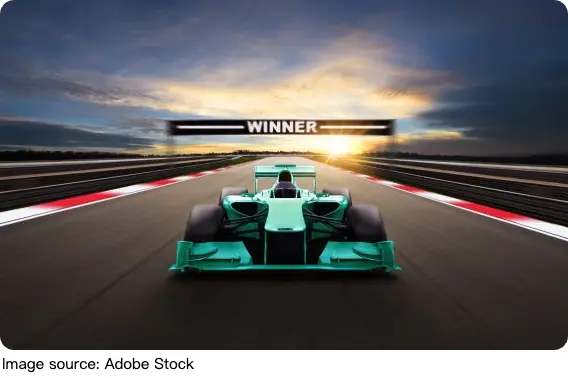
Every team used the same Dallara SF23 single-seater, originally designed for Japan's Super Formula championship.
Removing traditional driving controls transformed these racing machines into sophisticated robotic vehicles.
Cameras, radar and lidar sensors continuously monitored the surroundings, identifying track boundaries, nearby competitors and potential obstacles.
An onboard computer processed this information and determined how the car should respond.
The challenge was not simply staying on the circuit. Each vehicle needed to maintain competitive speed while anticipating other cars and avoiding dangerous situations.
The Real Competition Happens In Software
Although the vehicles were mechanically similar, their artificial intelligence systems were developed by different teams.
Engineers spent considerable time refining algorithms, running simulations and analysing performance data before the race.
Once the competition began, however, they could no longer make ordinary driving decisions for their vehicles.
For the Technical University of Munich team, this meant watching their carefully prepared system operate independently, knowing that even a small software mistake could affect the result.
The competition therefore tested engineering ability as much as outright vehicle performance.
Why Racing Matters For Road Safety
Autonomous racing might appear unrelated to everyday driving, but researchers believe it offers valuable opportunities for technological development.
Ordinary road testing cannot safely recreate every dangerous situation that an autonomous vehicle might encounter.
A controlled racing environment allows engineers to study difficult conditions, including rapidly approaching vehicles, unexpected manoeuvres and decisions made near the limits of tyre grip.
Alexander Winkler, A2RL's head of sporting, has highlighted the importance of testing these challenging scenarios under carefully managed conditions.
The resulting data could help researchers improve how autonomous driving systems respond to complex situations.
Can Artificial Intelligence Replace Human Skill?
Despite impressive technological progress, organisers acknowledge that autonomous vehicles still lack some qualities associated with experienced racing drivers.
Human competitors rely on intuition, creativity and years of practical experience when making tactical decisions.
Artificial intelligence processes enormous quantities of information rapidly, but developing comparable adaptability remains difficult.
Professor Marko Bertogna, from the University of Modena and Reggio Emilia, describes high-speed autonomous racing as an exceptionally demanding engineering problem.
For now, the most promising approach may involve combining human expertise with increasingly capable automated systems.
The Future Of Driverless Racing
Established in 2023, A2RL has developed from an experimental technology platform into a competitive racing series. The Imola event represented its first international competition after earlier events in Abu Dhabi.
Beyond the excitement, organisers hope that demonstrating autonomous technology in challenging conditions will improve public understanding and confidence.
Driverless racing is unlikely to replace conventional motorsport overnight. Nevertheless, the competition offers a fascinating glimpse of a future in which sophisticated software could play an increasingly important role in how vehicles move.