Across The Swiss Alps

Raghu Yadav
| 19-10-2026
 · Travel team
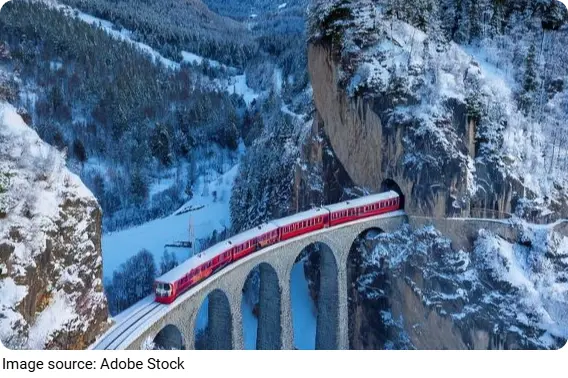
Imagine travelling from snow-covered mountains to a sunny Italian town in a single afternoon, watching the scenery change through enormous panoramic windows. Switzerland's Bernina Express makes this possible on one of Europe's most remarkable railway routes.
The complete journey from Chur to Tirano covers approximately 122 kilometres, passing through dramatic Alpine landscapes, 55 tunnels and 196 bridges. Part of the Rhaetian Railway is recognised as a UNESCO World Heritage Site, celebrating its exceptional engineering and spectacular mountain setting.
What Makes The Journey Special?
The train climbs through the Swiss Alps, passing forests, mountain villages, glaciers and high-altitude lakes before descending towards northern Italy.
One of the highlights is the Bernina Pass, where the railway reaches an altitude of approximately 2,253 metres above sea level.
Another unforgettable sight is the Brusio Spiral Viaduct, a remarkable stone structure that allows the train to descend through a circular route.
The full journey takes approximately four hours, while the shorter St. Moritz–Tirano section takes around two hours and 15 minutes.
When Is The Best Time To Travel?
Every season offers a different experience.
Winter brings frozen lakes, snow-covered forests and spectacular views of the surrounding glaciers. The contrast becomes particularly striking as the train descends towards the milder Italian landscape.
Summer offers green valleys, clearer hiking routes and opportunities to explore mountain villages.
Autumn brings colourful forests and quieter surroundings, while spring can combine snowy peaks with emerging greenery at lower elevations.
Train schedules vary seasonally, with fewer departures during winter, so checking availability before booking is essential.
Where Should You Stop?
St. Moritz is a famous Alpine resort surrounded by mountains and lakes. It provides a convenient starting point for the shorter railway journey.
Diavolezza offers access to spectacular high-altitude scenery, while Alp Grüm is particularly impressive for views towards the Palü Glacier and Val Poschiavo.
Further south, Poschiavo charms visitors with its historic architecture, attractive streets and Italian-influenced cuisine.
The journey ends in Tirano, where traditional buildings, mountain views and pleasant streets provide a relaxing introduction to northern Italy.
Travellers planning several stops should consider regular regional trains, which follow the same scenic railway and offer greater flexibility.
How Much Do Train Tickets Cost?
Ticket prices depend on travel dates, class and the selected route.
As an approximate guide, second-class return tickets may cost around €140, while first-class return fares can approach €240.
The panoramic Bernina Express also requires a compulsory seat reservation, generally costing approximately €40–50 per person, per journey.
This means a second-class return trip could cost roughly €220–240 once reservations in both directions are included.
The Swiss Travel Pass can cover the standard rail fare on eligible sections, but panoramic seat reservations must still be purchased separately.
Regional trains provide a potentially cheaper alternative because they do not require the same panoramic reservation supplement.
Swiss Alps
Accommodation And Food Costs
Accommodation can account for a significant part of the budget.
In St. Moritz, a standard double room may cost approximately €180–350 per night, particularly during popular travel periods.
Smaller towns such as Poschiavo may offer more affordable options, with guesthouses sometimes costing around €100–180 per night.
In Tirano, accommodation may be available for approximately €80–150 per night.
Allow €15–25 for a simple lunch and €25–45 for a restaurant meal in Switzerland. Dining in Italy can be more affordable.
Budget For A Three-Day Trip
For a three-day, two-night journey with two people sharing accommodation, an illustrative budget per person is:
Second-class return rail travel: €140
Panoramic seat reservations, both directions: €80–100
Accommodation for two nights: €100–250
Food and refreshments: €90–150
Local transport and activities: €30–80
Estimated total: €440–720 per person, excluding international flights and travel to the starting station.
Prices are approximate and may vary considerably with season and availability.
Tips For A Memorable Journey
Book panoramic seats early, particularly during summer and winter holidays.
Bring a camera, comfortable clothing and warm layers if you plan to explore higher-altitude stations.
Travellers wishing to visit several villages should consider spending at least two or three days along the route rather than completing everything in one afternoon.

With careful planning, this extraordinary railway journey offers an accessible way to experience Switzerland's dramatic mountain scenery and the cultural contrasts of the Italian border region.