Explore Wild El Nido

Kai
| 01-09-2026
 · Travel team
Welcome, readers. El Nido may look like the kind of place where you simply find a beach and spend the day under a palm tree, but the real experience begins when you leave the mainland behind.
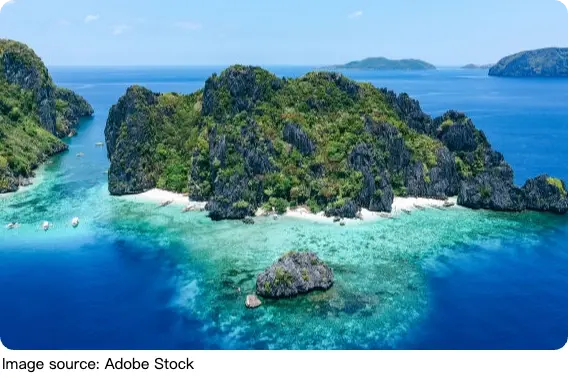
Traditional outrigger boats carry visitors across Bacuit Bay to limestone cliffs, turquoise lagoons, snorkeling spots, and small beaches hidden between towering rock walls.
Why El Nido stands out
El Nido sits at the northern end of Palawan in the Philippines and is best known for the dramatic limestone islands scattered across Bacuit Bay. The landscape combines steep karst cliffs, clear tropical water, coral reefs, and pockets of white sand often accessible only by boat.
Big Lagoon on Miniloc Island is one of the area's signature sights. Boats stop outside the narrow entrance, and visitors continue by kayak into calm water surrounded by enormous limestone walls. The water shifts from deep blue to turquoise and pale green depending on sunlight and depth. El Nido is beautiful from shore, but its maze of islands and lagoons is why most travelers spend at least one full day on the water.
Getting there and starting your trip
One common route is to fly into Puerto Princesa and continue north to El Nido by van. The road distance is roughly 267 kilometers, and the journey generally takes five to six hours. Shared van fares commonly cost around ₱700 to ₱900 per person, depending on the operator.
El Nido also has an airport at Lio, a short drive from town, with limited flights on selected routes. Travelers from Coron can reach El Nido by ferry, with fast services taking several hours depending on sea conditions.
The main town is compact enough to explore on foot, while tricycles are useful for reaching beaches and accommodation farther away. To experience the famous offshore scenery, however, you will need an island-hopping trip.
What to see on Tour A
For a first visit, Tour A is the classic choice. A typical itinerary includes Big Lagoon, Secret Lagoon, Shimizu Island, Payong-Payong Beach, and Seven Commandos Beach, although stops may change because of weather, sea conditions, or local regulations.
Big Lagoon is usually the highlight. Since motorized boats do not travel deep inside, kayaking is the best way to explore its calm water beneath towering limestone cliffs.
At Secret Lagoon, visitors pass through a small opening in the rock to reach a concealed pool surrounded by limestone walls. Shimizu Island is often used for swimming, snorkeling, or lunch, while Seven Commandos Beach offers a broad stretch of sand for swimming and relaxing.
Most shared tours leave around 9 a.m. and return at approximately 4 p.m., providing six to seven hours on the water.
Costs and fees
A shared Tour A generally costs around ₱1,200 to ₱1,500 per person in 2026. Packages commonly include the boat, licensed guide, life jackets, and lunch, although inclusions vary by operator.
Additional charges should also be considered. El Nido's Eco-Tourism Development Fee is ₱400 per person and is generally valid for 10 days. Big Lagoon has an additional entrance fee of about ₱200 per person. Kayak rental typically costs around ₱150 to ₱300, depending on the arrangement.
A traveler taking a ₱1,500 Tour A should therefore budget at least around ₱2,100 before optional rentals and personal expenses if the eco fee and Big Lagoon fee are not included. Carry Philippine pesos because small rentals and local charges are easier to pay in cash. When booking, confirm exactly which fees are included in the advertised price.
When to visit
The drier months are generally the easiest time for island hopping because calmer weather improves the chances of boats following their planned routes. However, conditions around Palawan can change quickly, and tours may be modified or canceled when the sea becomes unsafe.
Even if your boat leaves around 9 a.m., arrive early enough to organize your dry bag, sunscreen, drinking water, and snorkeling equipment. Wear swimwear beneath light clothing and choose sandals or water shoes suitable for wet landings.
A waterproof bag is particularly useful because passengers may need to walk through shallow water when getting on or off boats. Keep phones, wallets, and electronics protected even when the sea appears calm.
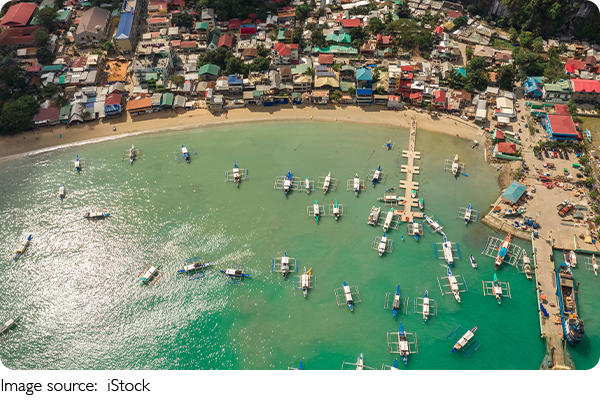
Bring cash and leave some flexibility in your schedule for changing conditions. The most memorable part of El Nido is not simply standing on a beach—it is sitting in a small boat as the town disappears behind you and the spectacular limestone islands of Bacuit Bay rise from the water ahead.