Survive the Sand Trap

Margot
| 30-08-2026
 · Automobile team
Welcome to today's article. We will review how to prepare a motorcycle and rider gear for desert travel to prevent heat-related mechanical issues and physical exhaustion. Liquid-cooled engines maintain operational temperatures through a combination of coolant fluid, a water pump, and a radiator.
Before entering a desert environment, technicians inspect the radiator hoses for micro-cracks and verify the coolant mixture meets the manufacturer specifications. Radiator guards protect the fragile cooling fins from flying gravel. Air-cooled motorcycles use external engine fins to dissipate heat directly into the passing air. These engines require steady forward motion.
When navigating slow, technical sections of deep sand, air-cooled engines risk overheating. Riders monitor oil temperature gauges and stop in shaded areas to let the engine block cool. Synthetic motor oil withstands higher operating temperatures than conventional mineral oil, providing stable lubrication when internal temperatures rise.
Tire Pressure and Sand Traction
High surface temperatures transfer heat directly to the motorcycle tires. This heat causes the air inside the tire to expand, increasing the internal pressure beyond the recommended specifications. Overinflated tires reduce the contact patch, decreasing traction on loose surfaces. Riders manually reduce tire pressure by 3 to 5 psi early in the morning before the ambient temperature rises.
Throughout the day, checking the pressure with a calibrated digital gauge ensures the tires remain within a safe operating range. Deflating tires slightly also allows the rubber to flex over rocks and float across soft sand patches rather than digging narrow trenches. You can try this right now: use a valve core removal tool to quickly drop tire pressure in controlled bursts, counting the seconds to achieve an accurate, uniform reduction across both wheels.
Rider Cooling and Hydration Strategies
Direct solar radiation and high ambient air temperatures rapidly deplete a rider's physical energy. A full mesh riding jacket provides abrasion resistance while allowing maximum airflow across the torso and arms. To enhance this effect, riders wear an evaporative cooling vest underneath the mesh outer layer. Soaking the vest in water activates the cooling process; as the wind passes through the jacket, the water evaporates and pulls heat away from the rider's body.
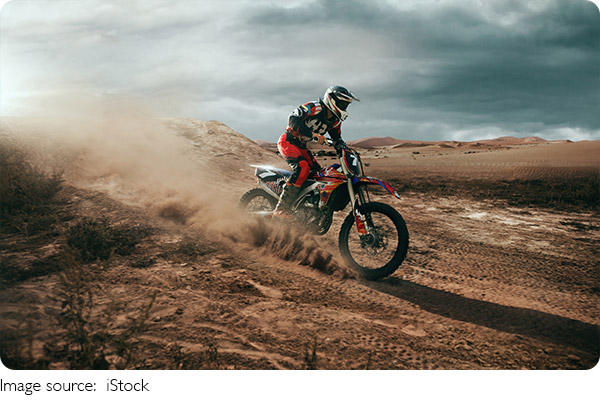
Dehydration severely impairs cognitive function and physical coordination. Operating a motorcycle in dry heat demands continuous fluid intake. Riders carry hydration backpacks equipped with drinking tubes, allowing them to drink without removing their helmets or stopping the motorcycle. A standard guideline involves consuming one liter of water per hour of riding time. Adding electrolyte powders to the water supply replenishes vital minerals lost through heavy perspiration.
Air Filtration and Drive Maintenance
Desert terrain features extensive amounts of fine dust, silt, and sand. The motorcycle engine requires massive volumes of clean air to mix with fuel for combustion. Standard paper air filters quickly clog in dusty conditions, restricting airflow and reducing engine power output. Adventure riders replace paper filters with oiled foam filters that trap fine particulate matter more effectively. Installing a pre-filter layer provides an additional barrier. Technicians remove and clean the pre-filter at the end of each riding day using specialized solvents and reapply fresh filter oil.
The motorcycle drive chain also requires specific attention in sandy environments. Traditional wet chain lubricants remain sticky and attract grit. This mixture of oil and sand forms an abrasive paste that rapidly wears down the steel chain rings and aluminum sprockets. Applying a dry, wax-based or PTFE chain lubricant provides necessary friction reduction without capturing environmental debris. Riders reapply this dry lubrication every 500 kilometers to maintain optimal drivetrain efficiency.
Fuel Planning and Route Navigation
Gasoline stations appear infrequently across desert landscapes. Running out of fuel in remote areas presents severe safety risks. Riders calculate the exact fuel consumption rate of their motorcycle under heavy loads and soft terrain, which typically reduces standard fuel efficiency by 20 to 30 percent. Carrying auxiliary fuel cells or robust fuel bladders extends the travel range. A standard safety margin requires carrying enough fuel to complete the intended route plus an additional 30 percent reserve for emergencies or detours. Desert navigation requires redundant systems.
Cellular network coverage drops entirely outside urban perimeters. Riders mount dedicated, rugged GPS units loaded with offline topographical maps. Following a pre-planned track prevents wandering off the established trail. In addition to electronic devices, carrying a physical paper map and a magnetic compass provides a reliable backup. Riders identify natural landmarks, such as distant mountain peaks, specific rock formations, or dry riverbeds, to verify their heading and maintain geographic orientation throughout the ride.
Preparing a motorcycle for desert travel requires specific modifications to the cooling, filtration, and fuel systems. Addressing these mechanical requirements alongside personal hydration strategies significantly reduces the risk of breakdowns and heat exhaustion. Riders apply these preparation steps to plan safe, continuous travel across arid environments.