Why Off-Roaders Drink

Mei
| 26-08-2026
 · Automobile team
Hi, let's get started. You might expect the extra fuel use in hard-core off-road vehicles to come mostly from the four-wheel-drive system itself, but that is not the whole story.
The real answer is split across several parts, and they stack up fast. A part-time 4WD setup adds hardware such as a transfer case, front differential, extra driveshaft, and axle parts.
In one clear example, a Jeep Grand Cherokee with 4WD was said to weigh about 300 pounds more than the rear-drive version. That added mass matters, but the bigger hit often comes from everything wrapped around the system, including shorter axle ratios, taller tires, and body shapes built for clearance instead of efficiency.

The hardware adds drag
A two-wheel-drive layout is simpler, but a 4WD vehicle keeps more parts turning. In a setup with a transfer case, front differential, and another driveshaft, you get more rotating mass and more mechanical friction. That means the engine has to keep pushing through extra internal resistance even before you talk about hills, mud, or rough tracks. A compact example made this easy to see: the Honda CR-V Real Time 4WD system added about 215 pounds compared with the front-drive version. Weight alone does not explain every mpg drop, but it gives you a concrete starting point for what the drivetrain contributes.
Weight matters, but not alone
People often point at curb weight first, and that is fair, but it is not the whole bill. The old rule of thumb mentioned here was that every extra 100 pounds cuts fuel economy by about 1 to 2 percent. Using that estimate, the 300-pound increase in the 4WD Jeep Grand Cherokee would account for roughly 3 to 6 percent worse mileage. Useful, yes. Huge, not really. If you are seeing a much larger gap between a trail-focused model and a street-focused one, you need to look beyond weight. That is where gearing and tire choice start doing real damage.
Gearing changes everything
Off-road vehicles are not just heavier, they are usually geared to pull harder at low speed. That means numerically higher axle ratios, and those keep engine rpm higher at cruising speed. Higher rpm means more fuel burned over the same highway distance. One direct comparison made this point well: a Chevrolet Tahoe with a 3.73 axle ratio had an EPA highway figure of 18 mpg, while the same model with a 4.10 ratio dropped to 17 mpg. That one-step change did not alter the whole vehicle concept, just the gearing, and you still lost efficiency. If you are asking how much of the fuel penalty comes from 4WD versus weight, gearing is the factor that keeps forcing its way into the conversation.
Tires and shape pile on
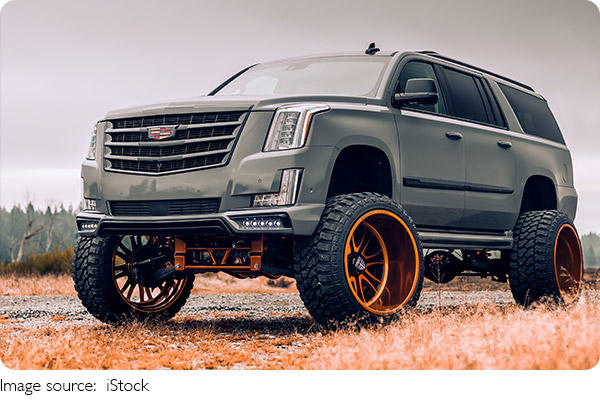
A road-biased SUV can look close to an off-road model on paper, but the details underneath change the result. Taller, wider, more aggressive tires increase rolling resistance. Greater ride height raises aerodynamic drag. Open space under the body disturbs airflow too. The Hummer H2 was the blunt example used for this problem. It was not thirsty just because it had 4WD. Its mass, tall stance, big tires, and shape all worked against fuel economy at the same time. That is why two vehicles with four driven wheels can post very different numbers. A car-based crossover with an on-demand system is carrying one type of penalty, while a body-on-frame trail rig is carrying several.
If you want a rough way to think about the split, the 4WD system itself contributes through extra mass and drivetrain losses, often in the low hundreds of pounds plus added friction. But in many hard-core off-roaders, a large share of the fuel penalty comes from the package built around that system, especially low gearing, tire choice, and bluff proportions. That is why you cannot pin the whole answer on one part. So when you look at a high fuel-use off-roader, read the full setup, not just the badge on the tailgate.