Chasing Icelandic Aurora
Mason O'Donnell
| 05-08-2026
 · Travel team
Northern Lights trips in Iceland are less about choosing one famous viewpoint and more about buying yourself enough opportunities.
The official aurora season runs roughly from late August through late April, but darkness, clear sky, and solar activity must coincide.
For Lykkers making a first aurora-focused trip, four nights around Reykjavík is a practical minimum. Reserve the first suitable evening for a guided chase, keep later nights available for another attempt, and never treat a sighting as guaranteed. A comfortable four-night trip can cost roughly 95,000 to 160,000 ISK per person excluding flights when two people share accommodation.
Reykjavík
Choose Your Aurora Window
The most important purchase is not an expensive excursion. It is enough nights in Iceland. Weather can hide an active aurora completely, so a one-night stop creates unnecessary risk.
Aim for September to March
September through March is the strongest practical window for most travelers because nights are properly dark. Official Iceland guidance notes that aurora activity is often particularly strong around the September and March equinoxes, while midwinter provides longer darkness.
For a first trip, consider late September through October or February through March. You gain substantial darkness without automatically choosing the harshest part of winter.
Do not plan an aurora holiday for June or July. Icelandic summer nights remain too bright for normal viewing.
Keep at least four nights available. Five to seven is better if seeing the lights is a major reason for flying to Iceland.
Stay in Reykjavík, then leave its lights
Reykjavík is the simplest base for first-time Lykkers because tours depart from the city and you avoid driving unfamiliar roads at night.
A basic private room may cost roughly 18,000 to 28,000 ISK nightly, while comfortable central hotels commonly fall around 25,000 to 45,000 ISK or more. Four nights can therefore require approximately 72,000 to 180,000 ISK per room depending on dates and comfort.
Food is another major expense. Allow roughly 2,500 to 4,500 ISK for a casual meal and 4,000 to 7,000 ISK or more for a sit-down dinner. Buying breakfast or lunch from supermarkets can reduce a four-day budget substantially.
Staying centrally costs more but makes late-night tour pickups and returns much easier.
Do not rent a car only for aurora hunting
A rental vehicle provides flexibility, but winter darkness, ice, wind, and rapidly changing weather make self-driving a poor default choice for inexperienced winter drivers.
A guided excursion is usually the better first-night decision. Current pricing for a small-group Northern Lights excursion is from 14,999 ISK per person, with a duration of approximately three hours. Private trips can cost dramatically more, with one current option starting from 160,000 ISK.
Group tours therefore offer much stronger value for most Lykkers.
Chase the Lights Properly
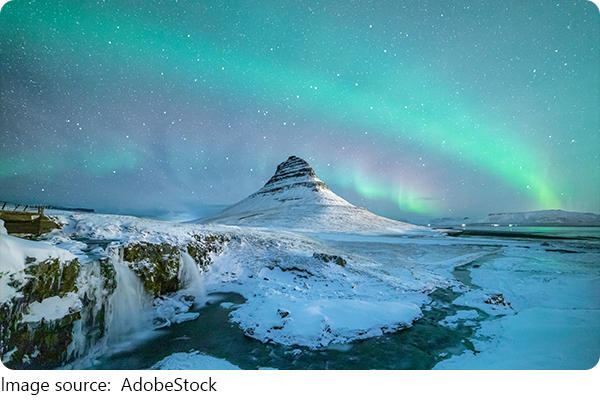
Your evening should follow the forecast, not a single location. A famous waterfall under solid cloud is useless for aurora viewing; an anonymous dark roadside clearing under clear sky can be excellent.
Check clouds before aurora strength
Use the Icelandic Meteorological Office aurora forecast on every potential viewing day. Its map combines cloud coverage with an auroral activity scale from 0 to 9. White areas indicate clearer sky while green indicates cloud.
Cloud cover is critical. Even strong auroral activity cannot be enjoyed through an opaque sky.
Do not cancel automatically because the activity number looks low. The Icelandic Meteorological Office notes that activity level 2 can still produce attractive displays and level 3 can be impressive.
Make your final decision in the afternoon rather than several days beforehand because Icelandic weather changes quickly.
Protect 22:00 to 01:00
Official Iceland tourism guidance recommends being outside roughly from 22:00 until 01:00, noting that aurora is on average most frequent around 23:00.
Do not schedule an early morning excursion immediately after every aurora attempt. A three-hour advertised tour can consume considerably more of your evening once pickup, driving, waiting, and return are included.
Wear thermal base layers, an insulating middle layer, waterproof outerwear, warm socks, gloves, and suitable footwear. Standing still outside feels much colder than walking around Reykjavík.
Bring a charged phone and power bank. Cold conditions reduce battery performance.
Use every second chance
Choose a tour with a clear retry policy. Some operators allow customers who see no aurora to join another departure without paying the full tour price again, subject to their conditions and availability.
This is why you should book your first chase on night one or two, never the final evening.
If the first night succeeds, later evenings become free for other plans. If it fails, you still have multiple opportunities.
Budget roughly 95,000 to 160,000 ISK per person for four nights when sharing a room, including accommodation, one standard aurora excursion, straightforward meals, and local expenses. Higher-end hotels and repeated paid activities can push the total far beyond this.
The biggest mistakes are booking only one night, visiting during bright summer, relying solely on an aurora activity number, and driving into difficult winter conditions without suitable experience. Give Iceland four or more nights, keep 22:00 to 01:00 flexible, check cloud cover every afternoon, and schedule your first chase early. For Northern Lights travel, Lykkers are not buying certainty. They are buying enough well-planned chances for nature to cooperate.