Moon Craters Explained

Kwame Johnson
| 05-06-2026
 · Science team
When we look at images of the Moon, one feature immediately captures our attention: countless craters spread across its surface. Some are relatively small, while others extend for hundreds of kilometers.
This naturally raises an intriguing question. If these craters were created by meteorites striking the Moon, where are those meteorites today? Why do we primarily see impact scars rather than the objects responsible for creating them?
To answer this question, we need to understand what occurs during a high-speed collision in space.
Why Do Space Objects Move So Fast?
Small rocky objects travel through space at incredible speeds. Many move at tens of kilometers per second. To put that into perspective, that is much faster than a jet aircraft flying through Earth's atmosphere.
Scientists believe that the motion of objects throughout the universe is linked to events that occurred during the early stages of cosmic evolution. Over billions of years, gravity shaped clouds of material into stars, planets, moons, and countless smaller objects. These objects continue moving through space along their own paths, often at very high speeds.
Because of this tremendous speed, even a relatively small rock can carry an enormous amount of energy.
What Happens When a Meteorite Hits the Moon?
When a meteorite collides with the Moon, the energy released is immense. The impact occurs so quickly that much of the object's motion is instantly converted into heat and powerful shock waves.
A simple comparison helps illustrate this process. If we repeatedly strike a metal nail with a hammer, the nail gradually becomes warm because some of the motion is converted into heat. Now imagine the same process occurring at thousands of times greater speed. The result is an extremely energetic impact.
The first thing created is a crater. Surprisingly, the crater is often many times wider than the meteorite itself. The impact can generate temperatures high enough to melt or even vaporize both the incoming object and the lunar surface around it.
In many cases, the meteorite breaks apart completely within moments. Fragments, dust, and molten material are scattered across a wide area. Afterward, there may be little evidence of the original object remaining.
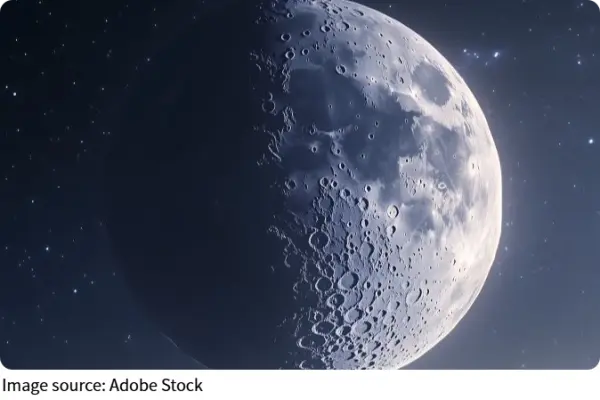
When a Dense Meteorite Strikes at a Shallow Angle
Not every impact follows the same pattern. Some meteorites are denser and more durable than others. If one of these objects approaches the Moon at a relatively shallow angle, the outcome can be quite different.
Instead of releasing all its energy at once, the object may lose only part of its speed during contact. It leaves behind a crater and a small amount of material, while the main body continues moving.
The Moon's escape velocity is about 2.4 kilometers per second. Since many incoming objects travel much faster than this, they can sometimes continue their journey back into space after the collision.
In certain cases, pieces of lunar material are also ejected. Some of these fragments travel through space for millions of years before eventually reaching other planetary bodies. Scientists have even identified rocks on Earth that originated from the Moon and Mars.
What Happens During a Direct Impact?
A much more dramatic event occurs when a dense meteorite strikes the Moon more directly.
The collision releases tremendous heat and pressure. The outer layers of the incoming object can melt or vaporize almost instantly. At the same time, part of the lunar surface experiences the same effect.
Some material is thrown outward and settles around the crater. Meanwhile, the strongest portion of the meteorite may move deeper into the surface material.
The crater's shape forms primarily during the impact itself, while molten and fragmented material may later settle within and around the crater. In some larger craters, the center may rise slightly, forming a central peak.
This process can effectively conceal the remains of the original object beneath layers of cooled material.
What About Slow-Moving Meteorites?
Occasionally, an object appears to be moving slowly relative to the Moon. However, this does not mean it is actually traveling slowly.
A useful comparison is two cars traveling in the same direction on a highway. One vehicle may appear almost motionless when viewed from the other, even though both are moving quickly.
The same principle applies in space. An object may have a low relative speed because its path temporarily resembles the Moon's motion. Yet its actual speed remains very high.
If its orbit differs from the Moon's, the object eventually moves away again. In some rare situations, very small objects can be captured by lunar gravity and settle gently onto the surface. However, these pieces are often so small that they are difficult to distinguish from ordinary lunar rocks.
Four Main Reasons We Rarely See Meteorites in Lunar Craters
After examining the different impact scenarios, we can summarize the main reasons why meteorites are often missing from lunar craters:
1. They shatter into countless fragments during impact.
2. They retain enough speed to escape the Moon's gravity and continue through space.
3. They become buried beneath molten and cooled surface material.
4. They are extremely small and blend in with surrounding rocks.
The Moon Still Holds Many Secrets
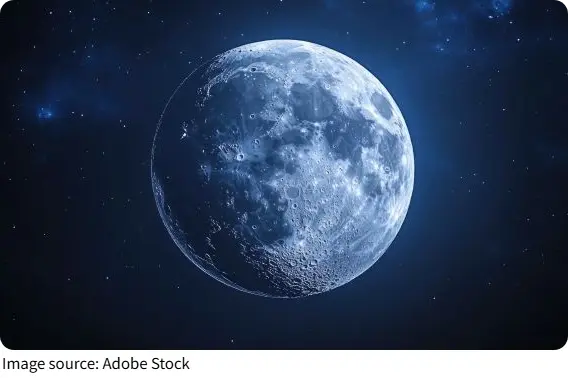
Lykkers, the next time we observe an image of the Moon covered in craters, we can appreciate that each one represents a record of an ancient collision. The missing meteorites have not simply disappeared. Some were destroyed during impact, some escaped back into space, some became buried beneath the surface, and some are too small to be easily identified.
Together, these craters form a natural archive of billions of years of Solar System history. By studying them, scientists gain valuable insight into how planetary surfaces evolve over time and how space environments continue to shape celestial bodies.