Saturn's Ring Mystery

Raghu Yadav
| 01-06-2026
 · Science team
Saturn is renowned for its extensive and visually striking ring system, making it one of the most recognizable planets in the Solar System.
Despite decades of observation and scientific study, the origin of these rings remains uncertain. Recent research has challenged long-standing assumptions about their age and formation, leading to renewed debate among planetary scientists.
Saturn's Remarkable Ring System
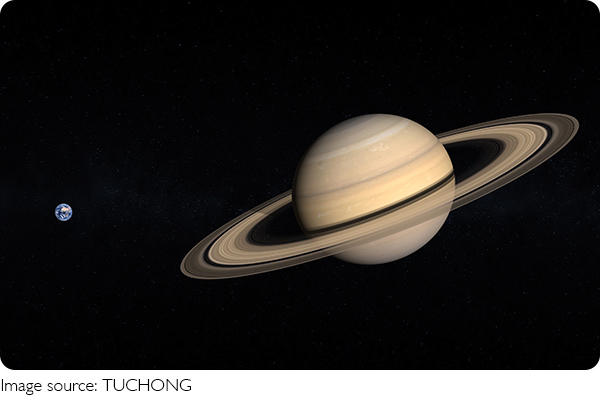
Saturn's rings are composed of particles ranging from micrometers to meters in size and consist primarily of water ice, with only small amounts of rocky material. These countless particles orbit the planet in a complex structure that extends hundreds of thousands of kilometers into space, creating one of the most distinctive features in the Solar System.
Are Saturn's Rings Surprisingly Young?
One of the most intriguing aspects of Saturn's rings is their possible age. While Saturn itself formed approximately 4.5 billion years ago, evidence gathered from spacecraft observations suggests the rings may be approximately 100 million to 400 million years old.
This would make the rings remarkably young compared with the planet they surround. Depending on their actual age, Saturn's rings may have formed while dinosaurs still inhabited Earth. Earlier theoretical models suggested the rings formed during the early history of the Solar System, but more recent observations have supported the possibility of a significantly younger ring system.
The Lost Moon Hypothesis
One leading explanation proposes that Saturn once possessed a moon known as Chrysalis. According to this hypothesis, gravitational interactions involving Saturn's moons eventually destabilized Chrysalis's orbit, causing it to move too close to Saturn.
Researchers suggest that the moon was torn apart by Saturn's gravitational forces. Most of its material is believed to have fallen into the planet, while a small fraction remained in orbit and eventually formed the rings observed today.
The Moon-Collision Hypothesis
Another major theory suggests that Saturn's rings originated from a collision between two icy moons. Computer simulations indicate that a high-speed impact between moons could produce large quantities of icy debris while leaving relatively little rocky material, consistent with the composition of Saturn's rings.
Some researchers propose that long-term gravitational influences gradually altered the moons' orbits until they eventually collided. The resulting debris could then have spread into orbit around Saturn and evolved into the ring system visible today.
The Importance of the Roche Limit
A central concept in both formation theories is the Roche limit. This is the distance at which a planet's tidal forces become strong enough to overcome the self-gravity holding a moon or other celestial body together.
Objects that cross this boundary can be pulled apart, preventing the material from reassembling into a larger body. As a result, debris can spread into a ring system rather than forming a new moon.
Shepherd Moons and Ring Stability
Several small moons orbit near Saturn's rings and help maintain their structure. These bodies, known as shepherd moons, use their gravitational influence to confine ring particles and preserve sharp ring boundaries.
Prometheus and Pandora play important roles in maintaining the narrow F Ring. Likewise, the Cassini Division remains largely free of particles because of an orbital resonance involving the moon Mimas. These gravitational interactions help preserve the structure and appearance of the ring system.
A Ring System That Continues to Evolve
Saturn's rings are not permanent structures. Observations indicate that ring material is gradually being lost to the planet through a process commonly known as ring rain. As a result, the rings were likely more massive in the past than they are today.
Titan is moving away from Saturn at a rate of approximately 11 centimeters per year, faster than previously estimated. Current research indicates that this outward migration continues to influence the Saturnian system, although there is no scientific consensus that Titan will eventually leave its orbit.
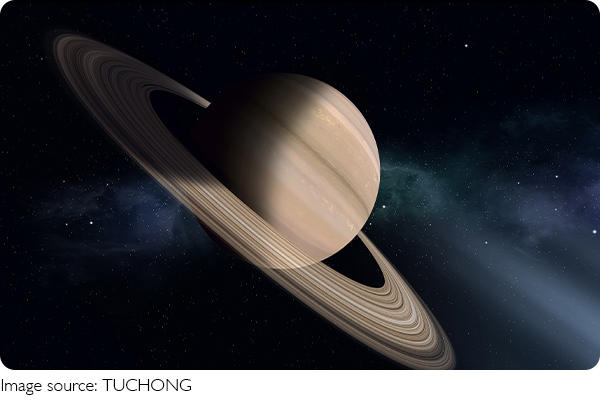
Saturn's rings remain one of the most compelling mysteries in planetary science. Although several well-supported theories attempt to explain their formation, no definitive answer has yet emerged. Whether they originated from the destruction of a single moon or the collision of multiple icy bodies, the rings continue to provide valuable insights into the dynamic processes that shape planetary systems. Ongoing observations and future research may ultimately reveal the full history of this remarkable feature.