Slow-Speed Skills

Caleb Ryan
| 11-05-2026
 · Automobile team
Ask any rider with serious mileage under their belt what separates good riders from average ones, and they'll almost never say cornering.
They'll say slow-speed control. Anyone can point a motorcycle in a straight line and open the throttle.
The real skill shows up when you're slowing down and pulling away from stops — that's when your technique is completely exposed.
How to Stop Smoothly
Start by checking your mirrors — every time you plan to slow down, know what's behind you. Make sure the handlebars are straight before braking. Braking with turned bars increases the risk of losing the front end. Then gradually roll off the throttle. Feel the engine braking begin, and time your brake application around it.
Apply both front and rear brakes simultaneously for a balanced, controlled stop. The front brake does most of the stopping work, but using both together lets you slow down faster and more evenly. The key detail: the first application of brake pressure should be very light — almost feather-light — and then gradually build.
A motorcycle tire can handle a massive load, but not an abrupt one. If the suspension lurches forward hard when you first touch the brakes, you're being too abrupt.
As you slow, pull in the clutch and downshift one gear at a time. Releasing the clutch between downshifts lets the engine help slow the bike through engine braking. Keep downshifting until you're in second, then as you near the stop, shift into first. Hold the clutch in at a complete stop — this keeps the bike from stalling and has you ready to move if needed.
In those final meters before stopping, slowly trail off the last 5% of brake pressure. This is what prevents that annoying forward-and-back bounce of the suspension as the bike settles. Left foot goes down when stopped; right foot stays on the rear brake.
How to Take Off Smoothly
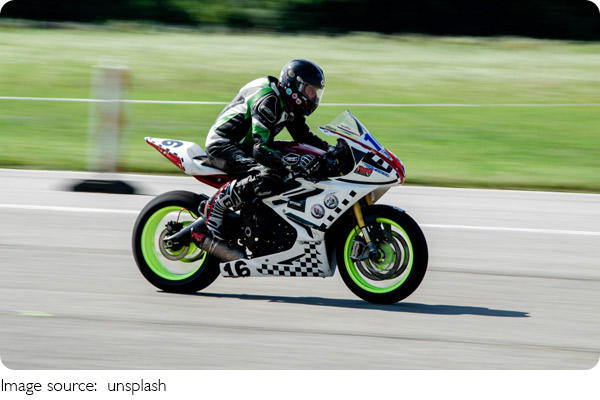
Taking off is actually easier — a bike in motion naturally wants to stay upright. Keep the handlebars straight at the start for predictability. The entire secret to a clean takeoff is finding the friction zone: the point in the clutch's travel where the plates begin to engage and you feel the bike start to pull forward.
Apply throttle gradually and consistently as you begin releasing the clutch. Not too much — excess throttle with a quick clutch release is how bikes lurch or tip. Not too little — and you stall. It's a balance that becomes instinctive with practice. The friction zone is your friend here; once you've found it, slow-speed balance gets dramatically easier.
Practice no-throttle takeoffs in an empty parking lot — using clutch control alone to get moving. When you can do that smoothly, your clutch feel will be precise enough to handle any real-world situation.
Anyone can go fast. The best riders move slowly with total control. Practice smooth stops in parking lots. Find your friction zone until it's instinctive. Left foot down, right foot on brake. Throttle and clutch working together. These small habits become second nature — and they're what keep you confident, controlled, and safe in every real-world situation.