The Owl's Secret Twist
Mason O'Donnell
| 11-05-2026
 · Animal team
Sit still and slowly turn your head as far as it will go.
For most people, that's somewhere around 90 degrees before things get uncomfortable. An owl turns its head three times that far — up to 270 degrees — without any apparent effort or discomfort, then snaps right back.
Watching it happen in real time feels slightly uncanny. For a long time, the question of how an owl does this without seriously injuring itself was genuinely unresolved.
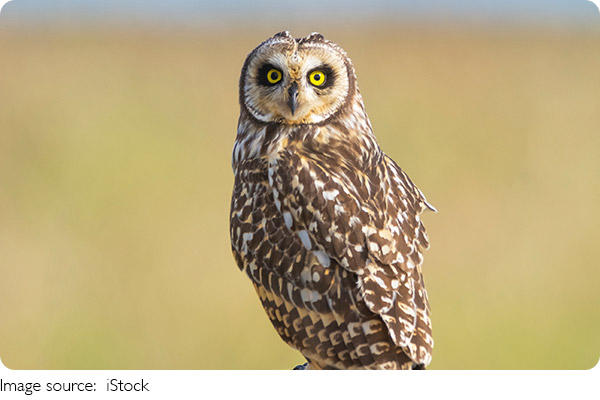
The reason owls need to rotate this far at all comes down to their eyes. Unlike human eyes, which are roughly spherical and can swivel in their sockets, an owl's eyes are more like elongated tubes — fixed in place by a bony ring called a sclerotic ring.
An owl simply cannot move its eyes within its head. To scan its surroundings, follow a sound, or track prey, it has no choice but to move its whole head instead. Wide-angle neck rotation isn't just convenient for an owl — it's essential for basic vision and survival.
The Problem That Stumped Scientists
Here's the issue that puzzled neurologists and anatomists for years: in most animals, including humans, extreme neck rotation is genuinely dangerous. The carotid and vertebral arteries that supply blood to the brain run through the neck, and twisting too far can stretch, compress, or tear their inner lining.
That kind of damage leads to clots, and clots lead to strokes. It's the mechanism behind certain whiplash injuries and, in some cases, chiropractic manipulations that go wrong.
For owls to be rotating 270 degrees multiple times per minute without any of those consequences, something about their anatomy had to be fundamentally different. A Johns Hopkins research team set out to find exactly what.
Using CT scans, angiography, and careful dissection of snowy, barred, and great horned owls that had died from natural causes, they injected contrast dye into the birds' arteries to mimic blood flow, then manually rotated the heads while imaging the vessels. What they found was a set of four distinct adaptations, each one addressing a different way the rotation could otherwise cause harm.
Four Adaptations Working Together
The first and perhaps most striking discovery was in how the arteries behave during rotation. In humans, arteries tend to get progressively narrower as they branch outward from the heart. In owls, the opposite happens at the base of the head — the vessels actually expand as the dye enters, forming small reservoirs of pooled blood.
These act as a buffer supply, ensuring that even when rotation temporarily pinches or redirects blood flow, the brain and eyes continue receiving oxygenated blood from the reserve.
The second adaptation involves the bony channels through which the vertebral arteries pass in the neck. In most birds and mammals, these channels fit closely around the artery. In owls, the hollow cavities surrounding the vertebral arteries are roughly ten times larger in diameter than the artery itself. That extra space allows the artery to shift and move during rotation rather than being compressed or twisted. Twelve of the owl's 14 cervical vertebrae have this adaptation.
Third, the vertebral artery in owls enters the cervical vertebrae higher up the neck than in other birds — at the 12th vertebra rather than the 14th. This gives the vessel more length and slack to accommodate the rotation without being stretched taut.
Fourth, small connecting channels called anastomoses link the carotid and vertebral arteries in a way not typically seen in human anatomy. These connections provide alternate blood-flow routes — if one pathway is partially blocked during extreme rotation, blood can reroute through the other. One specific connection, called a patent trigeminal artery, is a particularly reliable backup channel rarely present in mature humans.
What It Means Beyond Owls
The Johns Hopkins team noted that these findings also help explain why humans are comparatively vulnerable to neck-related vascular injuries. We lack almost all of the protective features owls have. Understanding the architecture of an owl's neck may even offer insights relevant to preventing vascular injury in human medicine — a reminder that biology studied on its own terms often surfaces unexpected applications.