Cat Night Vision Secrets

Declan Kennedy
| 27-04-2026
 · Animal team
When the lights go out and a room feels almost invisible to human eyes, a cat can still move with quiet confidence—stepping over furniture, tracking tiny sounds, and exploring shadows as if nothing has changed.
While this ability may seem mysterious, it is actually the result of several precise biological adaptations working in harmony.
Eyes Built for Low Light
A cat's eyes are structured to capture as much light as possible, even in dim environments.
Key features include:
- Large pupils that expand widely in darkness
- A reflective layer behind the retina that bounces light back through the eye
- High sensitivity to small amounts of light
- Eye shape that supports wide light intake
This combination allows cats to detect movement and shapes in conditions where humans see very little.
More Rods, Fewer Cones
Inside the eye, two main types of cells process light: rods and cones. Cats have a significantly higher number of rods, which enhances their ability to detect motion in low light.
What this means:
- Better detection of motion in low light
- Stronger ability to see contrast rather than color
- Reduced reliance on bright illumination
- Improved perception in shadows
This eye structure prioritizes movement and survival awareness over color detail.
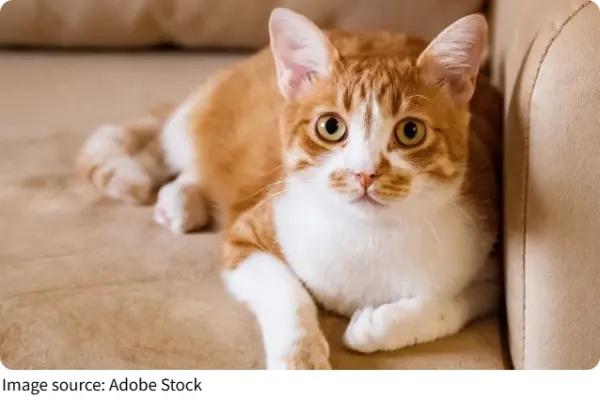
The Role of the Reflective Layer
Behind the retina, cats have a special reflective layer called the tapetum lucidum, which enhances their night vision.
How it works:
- Light enters the eye and passes through the retina
- The reflective layer sends unused light back
- The retina gets a second chance to detect it
- Overall vision becomes significantly brighter in the dark
This is why a cat's eyes often appear to glow when light hits them at night.
Motion Detection Superiority
Cats are especially skilled at noticing movement in low-light conditions.
This ability helps them:
- Detect small moving objects quickly
- Track subtle changes in their surroundings
- React faster to environmental shifts
- Maintain awareness even in near darkness
Instead of focusing on detail, their vision is tuned for motion sensitivity.
Trade-Offs in Color Vision
While cats excel in low light, their color perception is more limited compared to humans.
Key points:
- Fewer cone cells reduce color range
- Blues and greens are more easily distinguished
- Reds appear less vivid or muted
- Vision is optimized for function over color richness
This reflects their natural lifestyle needs and nocturnal hunting behavior.
Night Navigation in Daily Life
In home environments, these adaptations allow cats to move confidently after dark.
Common behaviors include:
- Walking through familiar spaces without hesitation
- Jumping onto furniture with precision
- Avoiding obstacles even in low visibility
- Exploring quietly during nighttime hours
Additionally, a cat’s spatial memory works alongside its vision, allowing smoother and more confident movement.
How Humans Compare
Humans rely more heavily on external light sources, while cats are built for low-light adaptability.
Differences include:
- Humans need more light for clear vision
- Cats rely more on motion and contrast
- Human eyes emphasize color detail
- Cat eyes prioritize survival perception in dim environments
This contrast highlights two very different visual strategies.

Final Reflection
A cat's ability to see in the dark is not a single trick but a combination of structural and functional adaptations working together. From light-sensitive eyes to motion-focused processing, every feature supports life in low-light environments. Understanding these adaptations not only demystifies their nocturnal agility but also highlights the brilliance of evolutionary design.