Kyoto's Higashiyama Guide

Celia
| 28-04-2026
 · Travel team
The street narrows to the width of two people passing with difficulty, stone-paved and climbing uphill between wooden shopfronts that have been selling the same categories of things — ceramics, textiles, preserved foods, handmade fans — for several centuries.
Above the rooflines on both sides, grey tile extends in every direction across the hillside, interrupted by the occasional dark cryptomeria tree and the distant green of the mountain behind.
Below, the street fills with people moving at the pace the gradient demands — slower than a city street, with more stopping, more looking, more awareness of the specific quality of the light falling through narrow gaps between eaves. This is Higashiyama, the historic district on Kyoto's eastern hillside, and it is the closest thing Japan has to a perfectly preserved pre-modern urban street.
Higashiyama runs along the base of the Higashiyama mountain range on Kyoto's eastern edge, connecting a series of temples, shrines, and traditional shopping streets in a continuous pedestrian corridor approximately three kilometers long. The district includes the famous approach streets to Kiyomizudera temple — Ninenzaka and Sannenzaka — as well as the quieter lanes of Ishibei-koji and the broader Sanjo-dori shopping street. Together they form one of the most rewarding walking routes in Japan.
Higashiyama Ward
What Higashiyama Actually Contains
The area's architectural character comes from the machiya — traditional wooden townhouses that line the district's streets in continuous rows, their narrow facades concealing surprisingly deep floor plans behind sliding wooden shutters and hanging cloth curtains called noren. Most of the machiya in Higashiyama have been converted to commercial use at street level — shops, tea houses, and small restaurants — while retaining the external architectural vocabulary that makes the district visually coherent.
Kiyomizudera temple, at the district's southern end, is Kyoto's most visited single site — a complex of wooden halls and terraces built into the hillside above the city, with the main hall's famous wooden stage cantilevered out over the slope on a framework of 139 wooden pillars assembled without a single nail. The views from the stage over Kyoto's rooftop expanse are among the most celebrated in Japan and completely justify the temple's crowds when experienced in early morning.
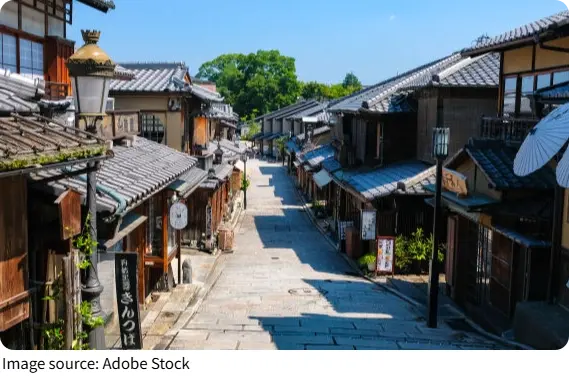
The approach streets to Kiyomizudera — Ninenzaka and Sannenzaka — are the lanes visible in the scene above. Ninenzaka means Two-Year Slope and Sannenzaka means Three-Year Slope, names derived from legends about the consequences of stumbling on their stone steps. Both are lined with machiya converted to shops and small restaurants, and both are worth walking slowly in both directions rather than simply climbing toward the temple.
Ishibei-koji, a short private lane between Ninenzaka and Kodaiji temple, is arguably the most beautiful single street in Kyoto — narrow, cobbled, lined with traditional inns and tea houses, and almost entirely free of signage or commercial clutter. It requires no entry fee and is open to pedestrians throughout the day.
Getting There
Kyoto is served by the high-speed train from Tokyo in approximately two hours and fifteen minutes, with tickets costing approximately $70 to $130 each way depending on seat type and advance booking. From Osaka, the journey by regular express train takes approximately 15 minutes at a cost of approximately $3.
Within Kyoto, the Higashiyama district is most easily reached by city bus. Bus lines 100 and 206 connect Kyoto Station to the Gion and Higashiyama area, with a journey time of approximately 20 minutes and a fare of approximately $2 per person. Taxis from Kyoto Station to the district cost approximately $8 to $12.
The district itself is entirely pedestrianized and must be explored on foot. Bicycle rental is available throughout Kyoto from approximately $8 to $15 per day and suits visitors wanting to connect Higashiyama with the northern Philosopher's Path and the Fushimi Inari shrine to the south in a single day.
Opening Hours and Key Costs
The streets of Higashiyama are freely accessible at all hours, with shops and tea houses typically opening from 9 a.m. and closing between 5 p.m. and 6 p.m. The approach streets to Kiyomizudera are at their quietest and most atmospheric between 6 a.m. and 8 a.m., before the first tour groups arrive.
1. Kiyomizudera temple — open daily from 6 a.m. to 6 p.m., with extended hours until 9 p.m. during specific seasonal illumination periods. Entry costs approximately $4 per person covering the main hall and the surrounding temple precincts.
2. Kodaiji temple — a Zen temple complex with exceptional garden design, open daily from 9 a.m. to 5:30 p.m. Entry costs approximately $6 per person and includes access to the bamboo grove and the tea house pavilions on the garden's upper terrace.
3. Maruyama Park — the large public park immediately north of Yasaka Shrine at the district's northern end, freely accessible at all hours. The park contains Kyoto's most famous cherry tree and serves as the primary transition point between Higashiyama and the Gion district to the west.
Where to Stay
Accommodation within or immediately adjacent to Higashiyama provides the most immersive experience of the district — the ability to walk the streets in early morning before the crowds and in the evening after the shops close produces a completely different character from the daytime visit.
Sowaka, a boutique hotel in a converted machiya on Ishibei-koji lane, offers rooms from approximately $350 to $550 per night and sits directly on the most beautiful street in the district. The location is unmatched for atmosphere and immediate access to the surrounding lanes.
Kyoto Higashiyama Youth Hostel provides dormitory and private room accommodation from approximately $30 per night for a dormitory bed and approximately $80 to $120 for a private room, within walking distance of Kiyomizudera and the Ninenzaka approach streets.
In the broader Gion and Higashiyama area, several traditional ryokan inns offer the full Japanese inn experience — futon bedding, multi-course kaiseki dinner, communal bathing facilities — from approximately $150 to $350 per person per night including dinner and breakfast.
What to Eat
Higashiyama is a haven for traditional Japanese flavors, with many tea houses offering serene views of temple gardens. You can enjoy a bowl of Kyoto-style Udon with thick tofu skins or a vegetarian Shojin Ryori (monk’s cuisine) set at a local restaurant for $15 to $25. For a mid-walk break, stop for a Matcha set featuring high-grade green tea and a seasonal Wagashi (handmade sweet) for $8 to $12. Travelers looking for a light snack should try Yatsuhashi, a cinnamon-flavored rice flour treat, or Mitarashi Dango (grilled rice dumplings in a sweet soy glaze) for $3 to $6. To drink, a cup of toasted Hojicha tea or a local fruit soda costs about $4 to $7.
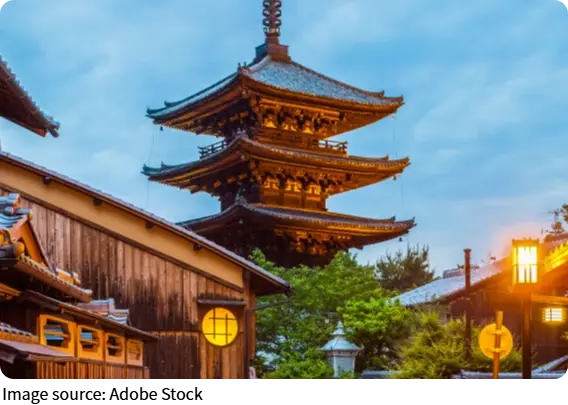
Higashiyama rewards the visitor who arrives early and stays late, as the district between dawn and dusk reveals a fundamentally different character from its crowded midday state. When the stone streets are empty and the low golden light falls through the gaps between rooftops, the spatial and architectural quality of the machiya houses becomes truly apparent. It is a place that proves the most profound travel experiences are often found in the quiet moments between the ticking of temple clocks and the rustle of bamboo leaves.
Walk these lanes twice—once at dawn to see the spirits of old Kyoto and once at dusk to witness the warm glow of paper lanterns—and the city will make considerably more sense than a single visit allows. The district acts as a vibrant reminder that even in a rapidly modernizing world, there are corners where the pace of life remains dictated by the gradient of a hill and the beauty of a season. Pack your most comfortable walking shoes and your curiosity; the eastern hills of Kyoto are calling, and their timeless grace offers a perspective that is both refreshing and eternal.