Albarracín Village

Raghu Yadav
| 11-05-2026
 · Travel team
The canyon drops away from the cliff edge without warning.
Vertical red sandstone walls drop sixty meters to a juniper and pine valley—striped rust, amber, cream: millions of years of ancient seabed.
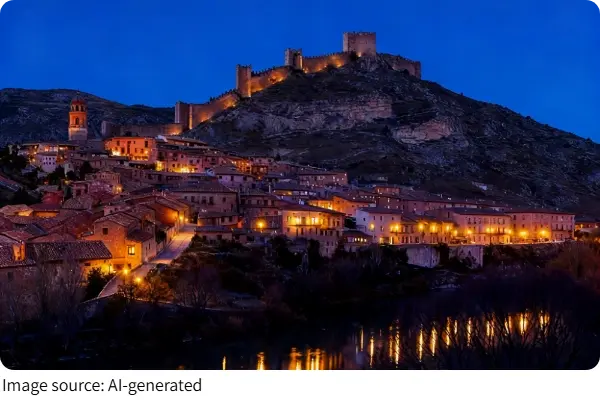
Behind you, the medieval village of Albarracín clings to the cliff in the same red stone—settlement and canyon made of exactly the same material.
Albarracín sits in eastern Spain, 200 km east of Madrid. Voted one of Spain’s most beautiful villages, it owes its charm to a river meander, a medieval street plan, and the red sandstone canyon on three sides—the same geology that draws climbers, hikers, and photographers seeking an unexpected Spain.
Albarracín
What Makes Albarracín Extraordinary
The village's relationship with its geology is total. The defensive walls that ring the hillside above Albarracín — some of the best-preserved medieval fortifications in Spain, stretching approximately 1,500 meters across the ridge — are built from the same red sandstone that forms the canyon walls below.
The cathedral, the noble houses, the narrow streets paved with rounded river stones, the overhanging upper floors supported on wooden brackets — all of it is colored in variations of the same deep terracotta that the surrounding landscape produces.
The canyon visible from the village's upper lookouts is part of the Sierra de Albarracín Natural Area, a protected landscape covering approximately 220,000 hectares of plateau, river valleys, and sedimentary rock formations.
The specific red color of the sandstone comes from iron oxide compounds in the rock — the same mineral that gives Utah's canyon country its characteristic palette — deposited during the Triassic period approximately 230 million years ago.
The Guadalaviar River has been cutting through this sandstone for several million years, producing the vertical-walled canyon sections visible from the village and a series of gentler meanders downstream where the rock gives way to softer material. The river is small enough to wade across in summer and clear enough to support a healthy population of brown trout, which makes the valley floor a productive destination for fishing as well as walking.
Getting There
Albarracín is located in a genuinely remote section of eastern Spain and requires a car for practical access. The nearest city with significant transport connections is Teruel, approximately 40 kilometers to the east.
From Madrid, the drive takes approximately two and a half hours via the A-3 motorway east and then north through Cuenca on the N-420 road. Car rental from Madrid Barajas Airport starts from approximately $35 to $55 per day for a standard vehicle. The final approach to Albarracín via the A-1512 road involves winding mountain road driving through the sierra — straightforward in good conditions but requiring care in winter when ice is possible.
From Valencia, the drive takes approximately two hours via the A-3 motorway west and then north on regional roads. From Zaragoza, the drive takes approximately one and a half hours via the A-23 motorway south and then west.
Teruel is served by train from Valencia and Zaragoza, with journey times of approximately two to two and a half hours. From Teruel, local buses connect to Albarracín with limited frequency — checking the schedule in advance is essential as services do not run throughout the day.
Key Experiences and Costs
Albarracín's main attraction is the village itself and the surrounding landscape — a combination that rewards slow exploration over at least two days rather than a single rushed visit.
1. The medieval village walk — the historic center of Albarracín is freely accessible at all hours, with the narrow streets, the cathedral, and the main plaza all within a compact walking area of approximately one square kilometer. The cathedral museum charges entry of approximately $3 per person and contains a notable collection of tapestries and liturgical objects.
2. The defensive walls circuit — a marked walking route follows the ridge above the village along the surviving sections of the medieval walls, offering elevated views over the canyon and the river valley below. The walk takes approximately one hour and is freely accessible.
3. Canyon hiking trails — several marked routes descend from the village into the surrounding canyon landscape, ranging from a two-hour riverside walk to a full-day circuit of the sierra plateau. Trail maps are available from the village tourist office at no charge. No entry fee applies to the natural area.
4. Rock climbing — the canyon walls around Albarracín contain over 300 documented climbing routes on high-quality sandstone, making this one of the premier sport climbing destinations in Spain. Guided climbing sessions with local operators start from approximately $50 to $70 per person for a half day including equipment.
Where to Stay
Accommodation in Albarracín is limited by the village's small size but includes several properties of genuine quality within the historic center.
Hotel Albarracín occupies a restored historic building in the village center with rooms from approximately $80 to $130 per night, within walking distance of the canyon viewpoints and the main medieval streets. Casa de Santiago, a smaller boutique property in a traditional house, offers rooms from approximately $70 to $110 per night with views over the surrounding landscape.
Several rural casa rural properties in the villages surrounding Albarracín offer self-catering accommodation from approximately $60 to $100 per night — a practical option for visitors wanting more space and kitchen access for a multi-day stay in the area.
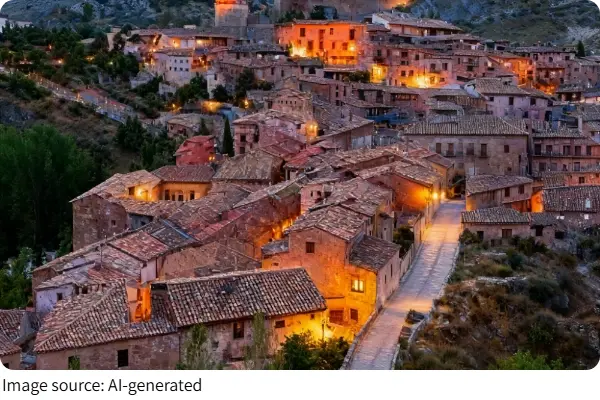
Albarracín works best for visitors who resist the urge to treat it as a day trip from Madrid or Valencia and instead stay long enough to walk the canyon trails at dawn, explore the village streets in the evening when the day visitors have left, and understand the relationship between the red geology underfoot and the red architecture above.
The canyon and the village are the same story told in two different registers — one natural, one human — and reading both takes more than a single afternoon.