Mu Cang Chai

Matteo
| 20-04-2026
 · Travel team
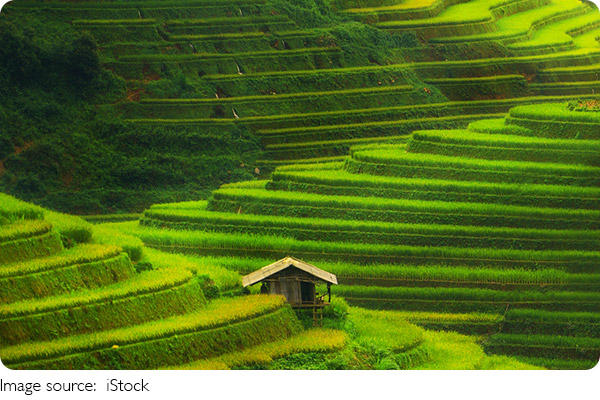
Seen from above, the hillsides of Mu Cang Chai look like a topographic drawing — thousands of curved contour lines, each a hand-carved terrace dropping hundreds of meters.
The golden sections are fields approaching harvest. The green sections hold younger crops. The red-brown lines between them are the earthen walls that hold the water and define each level.
Together they form a composition of such visual precision and scale that it registers as art before it registers as agriculture.
Mu Cang Chai
Mu Cang Chai sits in Vietnam's northwestern highlands, about 280 kilometers from Hanoi. The terraces were built by the H'Mong people, who have farmed here for generations, creating one of Southeast Asia's most dramatic agricultural landscapes. The area is a National Scenic Heritage Site, reflecting both its cultural significance and landscape quality.

What Makes Mu Cang Chai Different From Other Terrace Destinations
Mu Cang Chai's terraces cover 2,200 hectares across three communes. Their scale and steepness set them apart. Dramatic hillsides create tighter, more concentrated concentric curves from above.
Farming families maintain the walls by hand, inspecting and repairing them each pre-planting season. Water flows from higher streams via bamboo pipes and ditches. Keeping water levels across thousands of different-elevation terraces is a refined engineering achievement.
Getting There
Mu Cang Chai is located approximately 280 kilometers northwest of Hanoi, reachable by road in approximately six to seven hours. Several transport options connect the capital to the terrace district.
Overnight sleeper buses from Hanoi's My Dinh bus station depart in the early evening and arrive in Mu Cang Chai town in the early morning, allowing passengers to begin exploring at first light. Tickets cost approximately $10 to $15 each way. This is the most economical option and the most commonly used by independent travelers.
Private car hire from Hanoi costs approximately $100 to $140 for a full vehicle, covering the round trip or one-way depending on the arrangement. The drive passes through the mountain town of Nghia Lo and along increasingly dramatic highland scenery as it approaches the terrace area — the road itself, particularly the final 50 kilometers, offers elevated viewpoints over the valley that are worth stopping for.
Motorbike rental for the self-drive journey is popular among experienced riders. Rental from Hanoi costs approximately $15 to $25 per day. The route involves significant mountain road driving with steep gradients and narrow sections — appropriate only for confident riders with previous experience on Vietnamese highland roads.
Best Viewpoints and Practical Costs
The terrace district does not charge a formal entrance fee, but several specific viewpoints and observation decks within the communes have small access fees collected locally.
1. La Pan Tan viewpoint — the most celebrated and most photographed elevated position in the district, providing a panoramic view over the largest single concentration of terraces in Mu Cang Chai. Access involves a short uphill walk from the roadside parking area. A small community fee of approximately $1 to $2 per person is collected at the access point.
2. Che Cu Nha commune — the most remote of the three main terrace areas, requiring a longer drive on rougher roads from the main town. The terraces here see significantly fewer visitors than La Pan Tan and offer a quieter, more intimate experience of the landscape. No formal access fee.
3. De Xu Phinh — positioned on the opposite side of the valley from La Pan Tan, providing a different compositional perspective on the terrace system. The elevated road running through this commune offers multiple informal stopping points with unobstructed valley views.
The most rewarding times to visit are early morning between 6 a.m. and 9 a.m. — when mist fills the lower valleys and the light is soft and directional — and late afternoon from 4 p.m. until sunset, when the low sun creates strong shadow definition across the terrace walls and the golden fields glow most intensely.
Where to Stay
Accommodation in Mu Cang Chai ranges from simple guesthouses in the main town to homestay options within the farming communities themselves.
Mu Cang Chai Lodge is the most comfortable property in the district, a hillside lodge with elevated valley views and rooms designed to maximize the terrace panorama from private balconies. Rates start from approximately $80 to $130 per night during peak harvest season. Advance booking is essential during the September to October harvest window when the terraces are at their most visually dramatic and the lodge fills months ahead.
Guesthouses in Mu Cang Chai town offer basic but clean accommodation from approximately $15 to $30 per night, within walking distance of local restaurants and the transport connections to the main viewpoint areas.
Homestay accommodation within La Pan Tan and Che Cu Nha communes places visitors directly within the farming communities, with meals prepared by the host family and the opportunity to observe daily agricultural life from inside the terrace landscape rather than from a viewpoint above it. Homestay rates including dinner and breakfast typically run approximately $20 to $35 per person per night.
Mu Cang Chai rewards time, not a checklist. The terraces change with every hour, season, and elevation. The golden harvest lasts weeks, but the landscape has character all year — flooded, green, or stripped. The H'Mong have read these rhythms for generations. Taking two or three days reveals what aerial photos cannot.