Mountain Rings in Stone

Ravish Kumar
| 27-02-2026
 · Travel team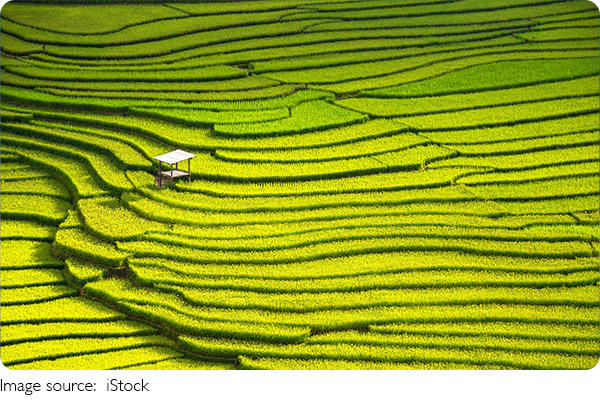
From a distance, terraced hillsides don't look man-made at all.
They curve gently around slopes, stacking one above another in repeating lines. If you've ever seen a freshly cut tree trunk, you know the pattern—concentric rings spreading outward, each one marking time.
Terraces create a similar visual rhythm. They wrap around the mountain in layered bands, almost like the land itself has recorded its history.
But that resemblance isn't accidental. It comes from how humans adapt to gravity, water, and slope. Once you understand the structure behind terraces, the “mountain rings” illusion starts to make perfect sense.
They Follow the Natural Contour
Contour alignment
Gravity management
Slope adaptation
Terraces are built along contour lines—the natural curves that run horizontally across a slope at equal elevation. If you look at a topographic map, you'll see contour lines forming loops around hills. Terrace builders follow those exact lines.
Contour alignment keeps each level stable. Instead of cutting straight across a mountain, terraces wrap around it, mirroring its shape.
This approach slows water runoff. Rain naturally flows downhill, but flat terrace surfaces interrupt that speed, reducing erosion.
By adapting to the slope instead of fighting it, terraces create smooth, repeated arcs.
That repetition is what makes them look like growth rings. Each terrace is a band, and together they trace the mountain's form.
Actionable example: If you want to see this clearly, open a satellite map view of a terraced hillside and then switch to terrain mode. Compare the terrace lines with the contour lines. You'll notice how closely they match.
The mountain's geometry dictates the pattern. Humans simply reveal it.
Layered Construction Creates Visual Bands
Step-by-step carving
Retaining walls
Level platforms
Terraces are built gradually. Farmers or builders cut into the slope, remove soil, and create a flat surface. The excavated material often reinforces the outer edge, forming a retaining wall.
First, a horizontal layer is carved into the hillside.
Next, the outer edge is stabilized with stone or compacted earth.
Then, soil is leveled to create a workable planting surface.
This process repeats again and again as the slope rises.
From afar, these stacked platforms create distinct horizontal layers. Just like tree rings vary slightly in width depending on growth conditions, terraces also vary depending on terrain steepness. On gentler slopes, terraces may be wider. On steeper hills, they narrow.
Actionable example: When visiting a terraced landscape, stand at a lower vantage point and look upward. You'll see how each level sits slightly behind the one below it, forming a stepped arc. That backward shift strengthens the “ring” illusion.
It's not decoration. It's structural necessity turning into visual poetry.
Water Reflection Enhances the Ring Effect
Seasonal flooding
Light reflection
Mirror-like surfaces
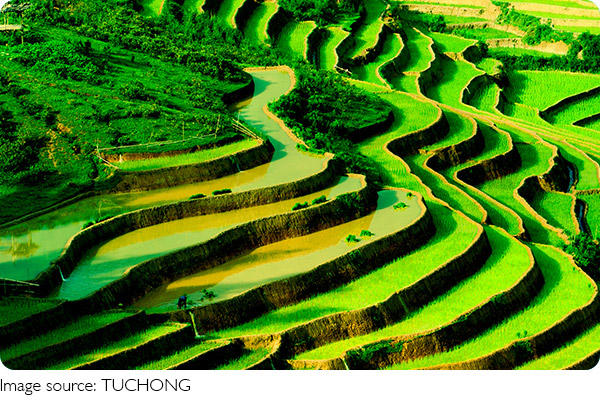
In regions where terraces are used for water-intensive crops, fields are sometimes flooded before planting. When this happens, each level becomes a shallow reflective pool.
Water smooths the surface visually, creating bright, curved lines.
Sunlight reflects differently at each height, emphasizing separation between levels.
The repeated arcs of light and shadow intensify the ring-like pattern.
Even when dry, the alternating textures—soil, vegetation, retaining walls—create contrast. Our eyes naturally group these repeating lines into patterns, much like we interpret rings in a tree trunk as markers of growth.
Actionable example: Visit terraces either early in the morning or late in the afternoon. The low sun angle exaggerates shadows between levels, making the “mountain ring” effect more dramatic in photos.
Light plays a huge role in how we perceive structure.
Human Time Embedded in Landscape
Generational labor
Incremental expansion
Visible history
Tree rings represent years of growth. Terraces represent years—sometimes centuries—of labor.
Many terraced hillsides weren't built all at once. They expanded gradually. A family might carve one level, cultivate it, then extend upward or downward over time.
Each terrace reflects a decision to invest labor into that slope.
Expansion often follows need—more food, more cultivation area.
Repairs and adjustments leave subtle differences in width and alignment.
When viewed as a whole, these layers resemble a timeline etched into the mountain. Instead of biological growth, it's human adaptation recorded in earth and stone.
Actionable example: Look closely at retaining walls. You may notice variations in stone size or construction technique between levels. Those differences hint at different building phases, much like thicker or thinner tree rings reveal environmental changes.
Terraces aren't random. They're cumulative.
Our Brains Love Repetition and Curves
Pattern recognition
Natural symmetry
Rhythmic spacing
There's also a psychological reason terraces remind us of tree rings. The human brain is wired to recognize patterns. Repeating curved lines trigger associations with familiar natural forms—shells, ripples, tree trunks.
The curves follow organic geometry, not rigid straight lines.
The spacing is consistent but not identical, which feels natural rather than mechanical.
The gradual scaling upward mirrors growth patterns we see in nature.
When you combine contour alignment, layered construction, reflective surfaces, and generational expansion, the visual result is strikingly similar to annual growth rings.
Actionable example: Next time you see terraced hillsides from a high viewpoint, squint slightly to blur details. The individual fields will merge visually into soft, circular bands—much like rings in wood.
That resemblance isn't a coincidence. It's what happens when human design cooperates with topography instead of resisting it.
Terraces look like a mountain's rings because they reveal the slope's inner structure while adding layers of human effort. They trace elevation the way rings trace time. One records climate and seasons; the other records labor and adaptation.
Stand back and you see geometry. Step closer and you see soil, stone, and careful leveling. Either way, those curved bands remind you that landscapes aren't static. They're shaped slowly—by nature, by people, and by years stacking quietly on top of each other.